> ## Documentation Index
> Fetch the complete documentation index at: https://docs.attensira.com/llms.txt
> Use this file to discover all available pages before exploring further.
# Tags
> Organize your Attensira prompts with tags for better analysis. Learn tag strategies by funnel stage, topic, priority, and audience — plus tips for filtering and reporting.
Tags help you organize prompts into meaningful categories, making it easier to analyze specific segments of your visibility data and manage large prompt sets.
 ## Why use tags
As your prompt library grows, you'll want to:
* **Filter results** by topic, audience, or priority
* **Compare performance** across different categories
* **Report on segments** to stakeholders
* **Manage prompts** in logical groups
Tags make all of this possible with flexible, multi-dimensional organization.
## Creating tags
Navigate to **Settings → Tags** and click **Add Tag** to create a new tag.
## Why use tags
As your prompt library grows, you'll want to:
* **Filter results** by topic, audience, or priority
* **Compare performance** across different categories
* **Report on segments** to stakeholders
* **Manage prompts** in logical groups
Tags make all of this possible with flexible, multi-dimensional organization.
## Creating tags
Navigate to **Settings → Tags** and click **Add Tag** to create a new tag.
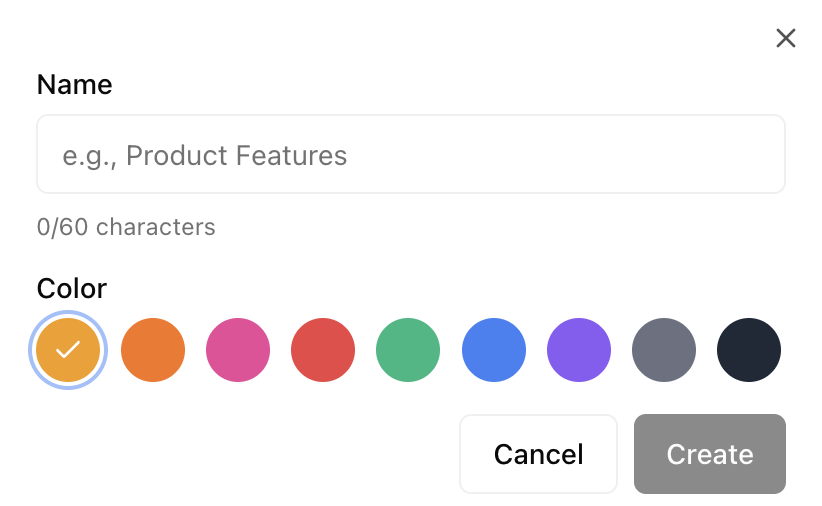 Enter a tag name, choose a color, and optionally add a description. Once saved, the tag is available to assign to prompts.
## Tag strategies
### By funnel stage
Organize prompts by where users are in their journey:
| Tag | Prompts |
| --------------- | -------------------------- |
| `awareness` | "What is \[category]?" |
| `consideration` | "Best \[category] tools" |
| `comparison` | "\[Brand A] vs \[Brand B]" |
| `decision` | "Should I use \[brand]?" |
### By topic/feature
Organize by what the prompt is about:
| Tag | Prompts |
| -------------- | ----------------------------- |
| `integrations` | "Tools that work with Slack" |
| `pricing` | "Affordable \[category]" |
| `security` | "SOC 2 compliant \[category]" |
| `mobile` | "\[Category] with mobile app" |
### By priority
Focus attention on what matters most:
| Tag | Description |
| ----------------- | -------------------------- |
| `high-priority` | Core queries you must win |
| `medium-priority` | Important but not critical |
| `experimental` | Testing new query types |
### By audience
Match prompts to personas and segments:
| Tag | Audience |
| ------------ | ----------------------------- |
| `enterprise` | Large company queries |
| `smb` | Small/medium business queries |
| `startup` | Startup-focused queries |
| `technical` | Developer/technical queries |
## Applying tags to prompts
### Single prompt
1. Open the prompt detail view
2. Click **Edit Tags**
3. Select the tags you want to apply
4. Save changes
### Bulk tagging
1. Go to **Prompts** list view
2. Select multiple prompts using checkboxes
3. Click **Actions → Add Tags**
4. Choose tags to apply to all selected prompts
5. Confirm
Use bulk tagging when importing prompts. Apply relevant tags immediately so your data is organized from the start.
## Using tags for analysis
### Filtering by tag
In any analytics view:
1. Click the **Filter** button
2. Select **Tags**
3. Choose one or more tags
4. Apply filter
The view updates to show only prompts with those tags.
### Comparing tag performance
View aggregate metrics by tag:
| Tag | Share of Voice | Avg Position | Sentiment |
| --------------- | -------------- | ------------ | --------- |
| `awareness` | 45% | 2.3 | +62 |
| `consideration` | 38% | 2.8 | +55 |
| `comparison` | 52% | 2.1 | +48 |
This helps you understand where you perform strongest.
### Tag-based reporting
Export reports filtered by tag for:
* **Stakeholder updates** — "Here's how we're doing on enterprise queries"
* **Content strategy** — "Here are the feature areas where we need to improve"
* **Competitive analysis** — "Here's our position in comparison queries"
## Multi-tag filtering
Combine multiple tags for precise analysis:
Show prompts with **all** selected tags:
`enterprise` AND `high-priority` = High-priority enterprise prompts
Show prompts with **any** selected tags:
`enterprise` OR `smb` = All business size queries
## Managing tags
### Renaming tags
1. Go to **Settings → Tags**
2. Click on the tag to edit
3. Update the name and save
All prompts with this tag will reflect the new name.
### Deleting tags
1. Go to **Settings → Tags**
2. Click the delete icon on the tag
3. Confirm deletion
Deleting a tag removes it from all prompts. The prompts themselves are not deleted, just the tag association.
### Tag cleanup
Periodically review your tags:
* Merge similar tags that have diverged
* Archive tags for discontinued campaigns
* Remove unused tags to reduce clutter
## Best practices
Choose a style and stick with it:
* Lowercase with hyphens: `high-priority`
* Or title case: `High Priority`
* Don't mix styles
3-5 tags per prompt is usually sufficient. More than that creates complexity without value.
Use prefixes to create logical groups:
* `funnel:awareness`, `funnel:consideration`
* `priority:high`, `priority:low`
Maintain a simple reference of what each tag means. This is especially important for teams.
## Tags and teams
For team accounts:
* Tags are shared across the team
* Anyone can create and apply tags
* Consider establishing tag conventions early
* Use tag descriptions to clarify meaning
## Next steps
Analyze which prompts are performing
Interpret your tagged results
Enter a tag name, choose a color, and optionally add a description. Once saved, the tag is available to assign to prompts.
## Tag strategies
### By funnel stage
Organize prompts by where users are in their journey:
| Tag | Prompts |
| --------------- | -------------------------- |
| `awareness` | "What is \[category]?" |
| `consideration` | "Best \[category] tools" |
| `comparison` | "\[Brand A] vs \[Brand B]" |
| `decision` | "Should I use \[brand]?" |
### By topic/feature
Organize by what the prompt is about:
| Tag | Prompts |
| -------------- | ----------------------------- |
| `integrations` | "Tools that work with Slack" |
| `pricing` | "Affordable \[category]" |
| `security` | "SOC 2 compliant \[category]" |
| `mobile` | "\[Category] with mobile app" |
### By priority
Focus attention on what matters most:
| Tag | Description |
| ----------------- | -------------------------- |
| `high-priority` | Core queries you must win |
| `medium-priority` | Important but not critical |
| `experimental` | Testing new query types |
### By audience
Match prompts to personas and segments:
| Tag | Audience |
| ------------ | ----------------------------- |
| `enterprise` | Large company queries |
| `smb` | Small/medium business queries |
| `startup` | Startup-focused queries |
| `technical` | Developer/technical queries |
## Applying tags to prompts
### Single prompt
1. Open the prompt detail view
2. Click **Edit Tags**
3. Select the tags you want to apply
4. Save changes
### Bulk tagging
1. Go to **Prompts** list view
2. Select multiple prompts using checkboxes
3. Click **Actions → Add Tags**
4. Choose tags to apply to all selected prompts
5. Confirm
Use bulk tagging when importing prompts. Apply relevant tags immediately so your data is organized from the start.
## Using tags for analysis
### Filtering by tag
In any analytics view:
1. Click the **Filter** button
2. Select **Tags**
3. Choose one or more tags
4. Apply filter
The view updates to show only prompts with those tags.
### Comparing tag performance
View aggregate metrics by tag:
| Tag | Share of Voice | Avg Position | Sentiment |
| --------------- | -------------- | ------------ | --------- |
| `awareness` | 45% | 2.3 | +62 |
| `consideration` | 38% | 2.8 | +55 |
| `comparison` | 52% | 2.1 | +48 |
This helps you understand where you perform strongest.
### Tag-based reporting
Export reports filtered by tag for:
* **Stakeholder updates** — "Here's how we're doing on enterprise queries"
* **Content strategy** — "Here are the feature areas where we need to improve"
* **Competitive analysis** — "Here's our position in comparison queries"
## Multi-tag filtering
Combine multiple tags for precise analysis:
Show prompts with **all** selected tags:
`enterprise` AND `high-priority` = High-priority enterprise prompts
Show prompts with **any** selected tags:
`enterprise` OR `smb` = All business size queries
## Managing tags
### Renaming tags
1. Go to **Settings → Tags**
2. Click on the tag to edit
3. Update the name and save
All prompts with this tag will reflect the new name.
### Deleting tags
1. Go to **Settings → Tags**
2. Click the delete icon on the tag
3. Confirm deletion
Deleting a tag removes it from all prompts. The prompts themselves are not deleted, just the tag association.
### Tag cleanup
Periodically review your tags:
* Merge similar tags that have diverged
* Archive tags for discontinued campaigns
* Remove unused tags to reduce clutter
## Best practices
Choose a style and stick with it:
* Lowercase with hyphens: `high-priority`
* Or title case: `High Priority`
* Don't mix styles
3-5 tags per prompt is usually sufficient. More than that creates complexity without value.
Use prefixes to create logical groups:
* `funnel:awareness`, `funnel:consideration`
* `priority:high`, `priority:low`
Maintain a simple reference of what each tag means. This is especially important for teams.
## Tags and teams
For team accounts:
* Tags are shared across the team
* Anyone can create and apply tags
* Consider establishing tag conventions early
* Use tag descriptions to clarify meaning
## Next steps
Analyze which prompts are performing
Interpret your tagged results